Showing posts with label Competitive Obedience. Show all posts

Tuesday, October 20, 2015

Expectations versus maturity - Part 2

Since I made that blog post last week about online acquaintances struggling with younger dogs in performance sports...I've done some more thinking while off showing in agility over the weekend and have more thoughts on this.

The more I think about this notion of pushing the maturity issue with younger dogs and the parallel idea of people. (I'm not going down the Anthropomorphism rabbit hole here.)  None of us would expect a 12 - 14 year old kid to go and work successfully on Wall Street as a banker...or as an tax accountant...or a police or fireman. We don't expect 12 - 14 year old kids to be able to work college level calculus. Yes, there are some exceptional kids who could take on college level courses or actual jobs like scientists or law enforcement....but they are exceptional and few and far between. Why do we expect that same level of maturity of our younger dogs for them to work at the same level as a 5 - 7 year old dog??

I was joking with an agility friend earlier this summer that Ocean at 3 was like a 21 year old college guy. A 21 year old old college guy is a mix of great choices and not so great choices. And that in a nutshell, was Ocean this past year...a mix or good choices in the ring and a mix of not so great choices. At turning 4 years old in a couple of weeks, Ocean is more or less equivalent to a 28 year old guy and 28 year old men can be successful at holding down an actual job and making a whole bunch of great choice with maybe a not so great one thrown in for fun. I'm really looking forward to this upcoming year with my true adult dog in agility.


I think there's something to be said about being honest with where your young dogs are in their mental maturity. Yes, a 12 month old large breed dog looks like a grown up dog. But their brain is still in puppy land. So, if you have the 4 legged equivalent of a 12 - 14 year old kid, try to allow them to stay in middle school where they belong instead of trying to shove them into post doctorate work.

Tuesday, October 13, 2015

Is your dog training fluid? Or is it written in stone?

I was just on a dog message board discussing with dog agility with a couple of members. The core discussion was someone was struggling with their young 18 - 24 month old dog's behavior when training. He's a Cattle Dog/Rat Terrier mix and as she put it, he was going through some sort of teenage boy jerk-face stage. His behavior was becoming combative, not listening, brain falling out of his ears, and just being a jerk for the sake of being a jerk. She had a training session that left her in tears earlier this week. She said that there has been a lot of regression in their training as of lately. She admitted that she felt like giving up and wasn't sure where to in her training or how to get his brain back into some sort of thinking mode. I'll post some of my responses below (bold and in italics) and actually build a blog post out of them and some comments that will help that happen.

I do hate to say it, but....you can't rush or train maturity in dogs. It will come on their own schedule. Ocean is just now turning into the agility dog I have been waiting for him to be this year....at the age of 3. Next year....at 4, that will be the year it all comes together with Ocean. I started trialing him at 15 months old. We had a couple of rough years of NQ's after NQ's after NQ's.

Just keep at building experience and mileage with him. That's why I just kept trialing and training with O. All of that mileage does add up. Do the best you can...but keep in the back of your mind you have a young dog who needs to mentally grow up (and there's not anything you can do to speed that up.) Take your training day by day and you'll see small improvements over time.


I've been seeing this trend online a bit with message boards, on facebook, and in real life with friends who are struggling with younger dogs. Younger dogs who are living in the shadow of expectation of these peoples other dogs....both past and present. Or, they are living in the shadow friends' dogs of similar age who are consistently performing in classes, practice, or at trials.

On the dog message board another poster had commented that her dogs matured well at the ages of 3 to 3.5 years old. My final thoughts from the message board discussion are posted below and will close out this quick, impromptu blog post. I really would like people to really take this sentence to heart and think about this when they are working and training with their dogs:

"You need to be able to adjust your training plan to the dog that is in front of you at that moment....not adjust your dog to your training plan."

^^^ In my humble opinion, that skill right there, is what separates the masterful and great dog trainers from all of the other dog trainers.


This totally supports that saying in dog training - "You really don't have a dog until 3." In my experience, 3 years old is when the dog settles into itself and they have the mental maturity to handle the stress that working them causes. I started to trial Lars in agility until he was about 2 months shy of 3 and in obedience for his CD when he was a couple of months over 3. If I had started to trial him in either before 3....both sports would have been a hot mess. Lars really settled into himself between the ages of 4 and 5.

I do know there are dogs out there who are out there who are consistent and awesome at younger ages. But you absolutely cannot compare your dogs to other dogs....including your own. You're going to do nothing but get frustrated over why isn't my dog like so and so's dog or my other dogs. Because they aren't those other dogs....they are who they are. You just have to embrace who they are....and all of who they are, good and bad. You have work and train the dog in front of you. Some days you may only be able to work on simple, foundation things because your young dog can't think their way out of a paper bag. The next day, you might be able to do a sequence. You need to be able to adjust your training plan to the dog that is in front of you at that moment....not adjust your dog to your training plan.

Last night, Ocean was a little crazy practicing at home because it was cooler outside. He was forgetting the concept of collecting if I'm holding my place on the course and not go blowing by me. We went back to something that we haven't had to revisit in months - Calling him into heel after one jump. He needed that exercise at that moment...and we did it a bunch of times until he got his head together. I didn't get mad, upset, or frustrated because my dog who is a P2, Open/Excellent agility dog was blowing by me and we needed to go back to basic agility foundation 101. I did recognize that at that moment we needed to go a bunch of steps back in order to go forward last night. Training dogs is fluid...it's not always onward and upwards every training session. Sometimes it needs to flow backwards or stay stagnant because the dog in front of you needs that.

Wednesday, September 2, 2015

Now I have my task packs....where do I find stuff to do (Part 1)

I decided to make a small series of blog posts that talk about how and where to find things to work on for the various cards that make up the task packs. I get asked "How will I know what to train?" a bunch from people who are thinking about purchasing tasks or that are new to their Train 'Em Tasks task packs. This is probably the second most popular question Train 'Em Tasks gets asked after "Are there any description exercises on the back of the cards?" I'm going to share my resources I pull my training plans from when I pull my own task cards from their grab bags. I'll also share where to find these resources for your own library of training resources.

I do have a fairly vast library of training references - books, DVD's, magazines, agility course maps from trials, seminar notes, and websites that I regularly pull ideas from that will match the task cards I pull myself. I have never, ever intended the task cards to replace working with an instructor or attending a class for the various things the task card packs are based on. I do understand that there are areas of the world where training facilities, classes, and instructors are hours away from my customers. I live in New England and I'm very fortunate I have numerous dog training facilities/instructors within an hour to an hour and a half drive. I tend to forget that isn't the case for everyone. But, that being said, the task cards aren't going to help anyone who has no idea what the exercise is on the task card. They are not meant to teach the exercise...just help you choose what to work on that day. Eventually, I will be producing products that offer basic exercise descriptions much like the Rally Prep Packs for the various dog training avenues we have products for. (I can hear the cheers from Task Nation over that news. **grin**)

The first reference book for Task Cards I'm going to chat about is for Competitive Obedience...mostly because it was sitting right here next to my laptop. I have two other Competitive Obedience books I'll discuss over the next week or two. The Art of Proofing  by Adele Yunck is one of my go to books for coming up for new ways to change up my obedience training routine with Lars. Yunck is also the co-author of one of the other books I'm going to be talking about soon. I'll quote the back of the book:


"Many exhibitors skip the crucial step of proofing when preparing to show their dogs in obedience trials. During proofing, you expose your dog to more and more difficult distractions to teach him to maintain his concentration and complete the obedience exercises. This book will help you explore proofing, whether by training by yourself, with a helper, or in a group. Author Adele Yunck draws on her extensive teaching and trialing background as she explores this fascinating subject."

This is a book that I wouldn't really use for a dog that is just learning competitive obedience exercises. Proofing is meant to test a dog's understanding on an exercise. Proofing a dog who doesn't have a good sense of the what you are asking of it isn't that fair. It's fair to ask a dog it's understanding when it is no longer learning but practicing what you've taught it. Proofing, when done correctly, builds confidence instead of destroying it. This is why I tend to do a lot of proofing exercises with Lars in obedience and Ocean gets more in the way of games in new things he's learning. I'm testing if Lars truly knows his job and I'm building his confidence for when things may go weird in the obedience show environment. It's not fair for me to ask Ocean to work through a hard distraction when he is just learning the game. I'll destroy Ocean's trust in me and his confidence in obedience if I push too hard, too fast.


One other little caveat about this book...Yunck does discuss the use of verbal and physical corrections with proofing. The idea of corrections has become a taboo to some dog trainers. My view on corrections is when used appropriately and fairly, they are an invaluable way to communicate information to the dog. Yunck does discuss how she uses corrections fairly in the book and I feel that it does a great job of explaining the correct and fair way to use corrections (verbal and physical.) If the idea of using corrections in your dog training makes you uncomfortable, please do not discount this book. You can still find this book incredibly helpful for ideas to challenge you and your dog in your training.


What I really like about this little book is that she has it all broken down by each competitive obedience exercise from Novice to Utility. So, if you pull any Train 'Em Tasks competitive obedience task card...this book has you covered with a slew of different things to add to your training. The first part of the book, Yunck discusses basic proofing concepts...things like timing proofs, if your dog anticipates, proofing attention, adding people, and other things like that. She has suggestions for proofing exercises when you're training alone at home, if you're training with a friend, or if your training with a group of people. Yunck makes it easy to tell what proof is appropriate by using a graphic of 1, 2 or 3 people. For example, a proof you can do yourself - use large stuffed toys either on the ground or in chairs for your Figure 8 Exercise. (Believe me, this book is LOADED with single person proofs you can do yourself.) A type of proof you can do with a friend - have someone repeat "Finish!" to make sure your dog waits for YOUR command rather than moving on the judge's command. A sample of one of the group proofs - have several people  clap and cheer after your dog responds to each of your utility signals as this will mimic the happy and astounded crowd of non obedience people watching your run.


Along with the proofing for each exercises and their various pieces, Yunck also has a small overview of what the exercise is and what is expected of you in the obedience ring when doing those exercises. I like this information for people who may be new to the sport itself or who have never gone to Open or Utility before. She helps take away some of the mystery of what the ring procedure is for each exercise. It also helps so people can practice the exercises in a way they will happen in the ring as well.

If competitive obedience is the game you want to play with your dogs...this book is a must have in my opinion. I pull my task cards in the morning and then I thumb through this book looking for things to try as proofs. Lars gets bored with obedience exercises if they are done the same way every time we do them in the backyard. He's a dog who likes to think and use his brain...using this book accomplishes that. Some of the proofs, he sails through with flying colors. Other proofs, he really has to think about the job at hand and sometimes he does falter and gets something wrong. But faltering is honestly a good thing because then we get to work on something and build both my knowledge and his confidence and knowledge.

So....where to get this wonderful little reference book?? Click on the links below and it will take you to the different merchants who carry it. :)

Dogwise


Max 200


Amazon


Tuesday, August 25, 2015

From the Competitive Obedience Grab Bag - Go outs and directed jumping with Lars

Oh wow, I didn't anticipate not blogging for 10 days! Transcendent Trainers has seemed to take on a little bit of a life of it's own. I ended up just getting my butt in gear and moving forward on that much more than I thought I would at the start of it. The positive feedback I've gotten on the products thus far has pushed me to make it more of a sister site than just a section in the Tasks website. Now, you can find the Transcendent Trainer Gear at www.transcendenttrainers.com and I'm planning on adding new things with new designs on a regular basis. So, so, SO excited about that project.

Things have been a little bit quiet on the training front here these past 10 to 14 days. Summer has hit us for one of those weeks...we had a heat wave which will make me (and the guys) hide in my basement where it stays cool. When I have felt motivated to train at dusk, it's been short sessions just to give the guys something to use their brains. But there was one night that I did video Lars' obedience training session of directed jumping.

Lars and I have taken a good chunk of time off from serious obedience training after the beginning of May. We both needed a break from working so hard on getting that UD. Not to mention, May was the beginning of Ocean's agility trial season. So, I just shifted gears and let Lars be a dog for a couple of months while Ocean became my focus. I've started to bring obedience back to the front training burners again. Lars and I did an obedience run thru a couple of weeks ago and a few things were rusty, as to be expected.


That was the full gamut of  what was pulled the night I worked Go Out's and directed jumping. Some of you Task fans might remember that Lars had a soft tissue injury in his shoulder last year. He earned two UD legs back to back right before the injury sidelined him for 7 months. Before that injury, he had rocking go outs and he would sit in the middle of the ring. After this 7 month rehab, his go outs became very inconsistent. Sometimes he would run straight but more often than not, he would hook hard to the right and line himself up to the high jump. That was just points. It was fine if the high jump was the jump he had to take. But....not so much if he had to run across the ring and jump the bar. Sometimes he would run somewhat straight and sit just to the right of the middle stantion. I've done a ton of thinking about this whole issue....and I more or less have come to the conclusion that Lars has forgotten where his end target it or that he feels as long as he's someplace along the back fence, that's correct.

One thing that I had done before the injury was use a target box for Lars to run and sit in a target box sort of like a picture frame. It was out there all...the...time when Lars did go outs. But it was big and clunky and a royal pain to lug around to run thrus. So, after the injury, I naively thought we didn't need it anymore. That's where the door to interpretive go out positions opened up. After these 2.5 months off from obedience, the box is coming back....but in a different form. I'm going to use a collapsible yard stick that I can make any size for Lars' go out target....and it will always be there.


Cutie pie Lars exhibiting where he must sit when he must go "AWAY!"
I bought this yard stick after we got the UD and I hadn't used it much this summer. Lars seemed to think that he should sit just to the right of the "box". Nope....Lars, that's not what I'm looking for, pal. That has become his default position when he does head out back straight.


We spent some of our directed jumping task time working on the idea of  your butt must be in the box for me to click my clicker and you get treats. (See...this is again why there are no exercise descriptions on the back of the task cards. You work on what you need to do that day.) I am big, big fan of using clickers in training and this is a perfect application for it. Lars and I use clickers for me to get across EXACTLY what I am looking for him to do. And Lars is a funny guy....because he will do things incorrectly, sort of incorrectly, and correctly to figure out what I am actually looking for. It's like...he's processing it all himself with "If I sit here....nope, okay....how about here?? Nope again huh....let's go back to where I got that click....yup, alright. Let me try 3" over from here....nope. okay." I let him be wrong....because that's how he figures it out.


Raised bed veggie garden beds make great go out distractions...

In that training session, he figured out what I wanted: his butt squarely in that v-shaped box. Then I started to add some distance with each attempt....clicking and rewarding when he nailed it. And there was no click and no cookies when he didn't. We got to this point at the end of the training session which I was very pleased with!


One thing I have to also work on is getting Lars to mark the go out spot better. That was one thing I didn't teach because I didn't know better. We're going to be adding that to our things to do list when go outs or directed jumping tasks are pulled.

Obedience trial season will be ramping up for the fall soon and this will be my project for the next several weeks. I'm sort of looking at this as a re-train instead of fixing. But, I think this will help us with our "where exactly am I supposed to be" question that seems to pop up more often than I like in the Utility ring. I will be reporting on how this turns out for us. ;)


Saturday, August 1, 2015

Suggested use for Rally Task Packs...

I just love talking with my Tasks Customers because they show me new and cool ways to use my products that I haven't thought of. I get to hear about great ideas from various sources. When someone purchases anything from Train 'Em Tasks, they get an invite to our Tasks Customer Community Group on Facebook. The Tasks Customers group is a great place to bounce ideas off of other Tasks users and they come from all different walks of dog training: Obedience, Rally, Agility, IPO, French Ring, Herding, Mondioring, and etc. I get Facebook messages and emails from past customers where they share how Tasks have changed their training sessions. Lastly, past customers find me at trials, run thus, and when I'm out and about training my own dogs and we chat about how we are using Tasks stuff. I think sharing info between trainers is so valuable. Sometimes having someone's different perspective on something you have been working on or through can help us see it on a much different angle.

One awesome idea that was passed on was for the different rally task packs we offer. This customer has the Train 'Em Tasks AKC Rally Novice Task Card Pack, a small Train' Em! grab bag, and the Full Sized AKC Rally Novice Sign Packs from us.


They were using the AKC Rally Novice Task Pack and grab bag to pull different task card signs so they could build their own course at home. Once they had enough cards that they could have a full sized AKC Rally Novice Course (10 - 15 signs,) they would arrange them on a table like they would be on a map you would get at a trial. They took a photo of what they pulled and built with their phone and then headed outside with their full sized signs. Using their phone pic of the tasks, they can build a rally course on their own.

This is brilliant and I love it. The more I do Train 'Em Tasks, I find that people do not have regular access too classes and run thrus like we do here in New England. A lot of people are going forth and learning rally on their own because they are in remote areas or in places where competitive dog sports is not popular. Using our rally task packs and our full sized signs with the exercise descriptions on the back can totally work for someone who doesn't have access to rally maps because they are new to the sport. It can also work for someone who may have a limited amount of rally maps or outdated (pre 2012) rally maps from past trials. I have blogged in the past about using Tasks in the classroom. This method of using rally tasks and signs could absolutely work there too. The students could pull the task cards and arrange them into a course they want to work on. For anyone who is in levels higher than AKC Rally Novice can do this same method of pulling cards with the AKC Rally Taskmaster Collection (Novice - Excellent and a large grab bag) and our Full Sized Complete AKC Rally Sign set.


Right now we have task card packs and full sized sign packs for WCRL (formerly known as APDT) rally and using them this way would totally work too. I'm hoping to finalize the task packs and full sized sign packs for the other venues of rally we carry in Prep Pack form this fall.

Thursday, July 16, 2015

Spiritual gangsters and dog training

So, I will fully admit, the Tasks blog has been put on the back burner this spring while developing new products and working on a myriad of other things with the boys and even on myself.

That is where the title of today's blog post comes from...the hard work I have been doing on the inside. Long story short, I started to see a mental health professional almost a year ago now because there was a lot in my life that wasn't working for me. At the time, I thought it was burnout from my former day job with an undercurrent of depression. It infiltrated everything...work, personal life, and even the journey I walked with the boys. It wasn't until about 4 - 5 months into the sessions that we had a big break through...I wasn't burned out or clinically depressed. I was Codependent. What that means in a nutshell, I learned a lot of self defeating mental survival skills as a kid growing up in a dysfunctional household that I carried into and cling to as an adult. To quote Codependent No More, the book that has more or less redefined my life - "Codependency involves a habitual system of thinking, feeling, and behaving towards ourselves and others that cause us pain. These habits are self destructive." Codependent people worry about, obsess over, and try to control other people and events that are not our business to worry about, obsess over, and try to control. We enmesh ourselves in external things and people and detach from ourselves. Codependent people also have low self worth. We don't feel good about ourselves and we don't like ourselves very much. We tie our self worth to accomplishments and external things/events.

That has been my operating system for 40 or so years and removing that virus from my operating system is going to take some time. It's been slow going and I have had moments where its easier for me to fall back on familiar, old habits. But, it is getting better every day and I am putting one foot in front of the other on the path of codependency recovery. I'm working hard on detaching from everything that isn't my direct responsibility. The only thing I'm responsible for is me (isn't that a radical thought!) I'm working very hard on placing my own needs first and practicing self care (physically and emotionally.) I'm working very hard on developing the idea that what other people think of me is really none of my business. I'm letting go of all things that I can't control (which is everything but my own actions, feelings, and thoughts.) I'm becoming a spiritual gangster.


So....what does all of  have to do with dog training?? Actually, quite a bit. I know that I was taking dog training and the end goal of getting titles way too seriously for my own good. I see a lot of people who are in dog sports who also take dog training and getting those scores/titles way too seriously for their own good too. A dear friend of mine asked why I was driven by the need to be perfect...why was I so scared to fail or even make small mistakes? I would get defensive with instructors or friends who were trying to give me constructive criticism. They were trying to help me...but I took their input as attacks against my fragile self image. I couldn't process what they were trying to tell me in a healthy way. I couldn't process much of the world in a healthy way.

 With my new self awareness in place, I started to question why that was with me and speculated why that was with others too. I was basing my self worth on getting a Q or a title, or a great score. I worried way too much about what others thought about me as a person if I didn't Q, get that title, or that great score. Last year, agility caused me an incredible amount of angst because I could not Q with Ocean at 24" to save my life. Towards the end of the summer, I broke down at a trial and sobbed to friends saying "Why is this so hard?" My self worth took a huge tumble...I couldn't get my dog out of novice and I had been listening to advice from people. I wasn't listening to my own voice because of that poor self worth...I had detached from my own wisdom. It wasn't long after that agility break down that I moved Ocean back down to 20" to where he should have been. Wouldn't you know it, we're back to getting those Q's on a regular basis.

My new favorite dog sport shirt!!

Over these past couple of months with this new self awareness, I've learned where we are in our own head-space massively impacts training and working our dogs. We hear so much about the psychology side of sports and I don't think the obedience world has really looked at how that can impact their performance. The agility world's more competitive teams are aware of the mental game....but does the average agility team struggle with it? I surely didn't think that my everyday undercurrent of mental crap impacted how I trained or showed. But it did...and did a lot. I wasn't ready until now to really come out and talk about this recovery I'm working on. Now that I am ready, I'm probably going to write about it as it pertains to dog training.

If you see yourself in anything I wrote above, you're not alone. Codependency is a common issue for people who have lived/grew up with family dysfunction, alcoholism, mental illness, or abuse. Codependent No More by Melody Beattie is a life changing and validating book. I highly recommend it to anyone who knows or thinks codependency is part of their life.

Sunday, April 12, 2015

UTILITY DOG LARS!!!!!

- LARS EARNS HIS AKC UTILITY DOG TITLE (UD!) He finishes up his title with a first place and then picks up a spare UD leg with another first place at the second trial of the day!!! WHOO HOO LARS!!!!! 


URO2 UCD UCH Deerwood's Larson Bravo Zulu UD GN RAE NJP NAP NFP OCC OJC TG-E EAC O-WV-E S-TN-E APDT RL2 AOE-L1, L2 HIC TT CGC TDI

(All Breed Obedience High in Trial Winner - 2010 American Rottweiler Club Agility Top 10  - 2011 Colonial Rottweiler Club Agility Top 10 - 2012 American Rottweiler Club  Open Obedience Top 10 2013 - American Rottweiler Club Final Rally Top Ten - NADAC Novice/Open Versatility - 2012, 2013 NADAC Judge's Choice Award - 2012, 2013 NADAC #1 Rottweiler.)

Monday, February 9, 2015

Why are there no exercise descriptions on task cards...

That is a very common question that we get from customers...or the derivative question: "Are there descriptions on the task cards?" There are no descriptions or tips or anything like that on the task cards. (The prep packs and full sized rally signs are a different creature and they do have information featured on them. ) The task cards are blank on the back by design.

Here is a perfect example of why there are no exercise descriptions on the back of the task cards. Recently, "Scent Articles" from my AKC Utility Obedience task pack was pulled. Lars worked on his turn and sits sends mostly and worked the scent pile like we normally do.


But, Ocean needed something else when it comes to scent articles which I have never had to do before with a dog. He got to play the "shell game" for his scent article task. He doesn't understand this is a job where he uses his nose...find the food under the right cup = "search" which is my article command. He's starting to get it and I think I can start moving this game to two articles soon. (Ocean thinks he needs to bring me all of the articles!)

Then fast forward a couple of weeks of slowly transitioning from the red dixie cups to actual metal scent articles. We slowly increased the number of metal articles so Ocean could be right more than he could be wrong. But now, he understands and really likes this "search game!" He cheats and watches me where I put the article...that's why he has to hide in the bathroom. I had dropped a piece of food under the article by accident when I placed it...I was pleased that he wasn't distracted by it and took the article instead of the food first.


This is why I don't spell out how to do stuff on the backs of the cards. The what you choose to do with the task has to fit where you dog is that day. The task cards are there to start the gears turning in your head...and not train by flow chart. Do you need the full exercise that day? Do you need a game derived from that task? Or, do you need a small part of that exercise to be more polished? This is how the task cards work...to guide you and to get you to really think and focus what you will work on that day.

Monday, October 6, 2014

Goofing around with Go Outs

So I pulled "Go Outs" as one of Lars' obedience tasks earlier last week. My husband is up on the deck with O so I'm not talking to myself. LOL I use a target box at the top end of the ring for Lars' (and Ocean's go outs.) I didn't want the food on the ring gate to be the sole reason Lars is running away from me. I wanted to teach the go out as a position (like I do with front.) I could totally see him charge out there and wipe out the entire back ring gate searching for food that he is certain is there. With his drive, he won't stop looking for it until he finds the food. With running out to the position where the box is, I wanted Lars to know he has to run straight out away from me and get into the position the box is marking. In run thrus and practice, the box is always there...it's only gone in trials. Just like that plunger for the Broad Jump that's always there, it's there to build muscle memory to run straight and do a tight turn and sit. 

The way Lars thinks is the other reason I used this method over food...he understands that he must run away from me and get into this position in order to run back to me and take a jump. Running and jumping is one of Lars' most favorite things to do. Lars didn't "get" go outs until it started to get paired with Directed Jumping...and then it all made sense to Lars and why running to the opposite ring meant something. I actually use the directed jumping as a reward sometimes for a good go out. He only gets to jump if he is in the position I want. If he gives me a crap go out, he doesn't get to jump...and I have to become more of a stickler of that in run thrus. Ocean doesn't think like Lars does...and I'll probably have to adjust some of this when it's his turn to really learn this go outs and directed jumping. But, so far, it's working for Lars.


Tuesday, September 30, 2014

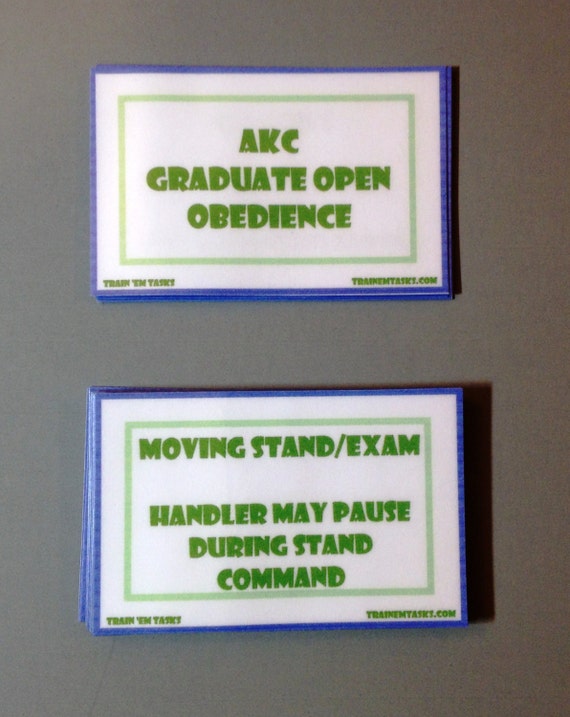
What new, cool things from Train 'Em Tasks - Graduate Open Task Pack!

Here's the newest product to come down the Train 'Em Tasks pipeline - our Graduate Open Task Pack!


The AKC has a set of classes which are on the "Graduate" level of their obedience classes. They offer both Graduate Novice for those dogs who have earned their CD (Companion Dog) title but aren't quite ready for the Open obedience ring. They also have a Graduate Open class for dogs with their CDX (Companion Dog Excellent) but have more work to do before they enter the Utility obedience ring. These transitional obedience classes offer similar exercises to Open (for Graduate Novice) and Utility (for Graduate Open) but, those exercises are a little bit easier for the handler/dog team. Train 'Em Tasks does have a task pack for Graduate Novice already available to customers and I'll make a blog post about that at some point. Today, I'm going to focus on Graduate Open. ;) Both of the Graduate Novice and Graduate Open Task Packs are found in our Competitive Obedience Product section of our Etsy shop!
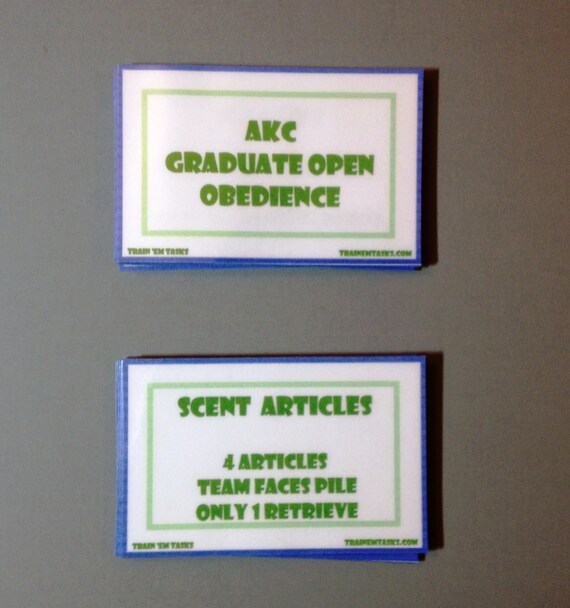

Graduate Open is a great stepping stone for dog/handler teams who in between Utility and Open in their showing career. In the Graduate Open class, the exercises are the same basic exercises that are found in the Utility ring: Signal Exercise, Scent Discrimination, Directed Retrieve, Moving Stand/Exam, and Directed Jumping. Unlike the Utility ring, Go Outs are a separate exercise on their own where in Utility, they are part of the Directed Jumping exercise. The title abbreviation for Graduate Open is GO and to earn that, you must qualify 3 times under 2 different judges, just like the regular obedience classes.

What makes the Signal Exercise different in Graduate Open versus Utility? A couple of things and you'll see that it's just a couple of small things with all of the exercises. To be able to pull off a qualifying score in Graduate Open, the dog and handler has to have a good grasp on the Utility exercises and be actively working towards the Utility ring. So, in the GO Signal Exercise, the heeling part is the same as UD Signal Exercises would be. But in GO, the handler may give the command and/or signal the dog to stand when told
by the judge. The handler will leave the dog and walk out about 10 - 20' and the judge will signal to down, sit, come, and finish.
Scent Discrimination in Graduate Open is one article only and not two like the Utility ring. It is up to the handler if they will use a metal or leather article for the article the dog will bring back. The pile is made up of only 4 articles (2 metal and 2 leather) and the dog/handler team will stay facing the pile during the whole exercise. So,  there are some significant changes to the Scent Discrimination exercise to make it more doable for a Graduate Open team.

Directed Retrieve Exercise or as a lot of people call it the glove exercise has pivots and the same distance between the dog/handler team and the gloves as the exercise would in the Utility ring. The GO difference for the Directed Retrieve exercise is there is no glove 2 in the center. So, the dog and handler only has to worry about gloves 1 and 3 which are located in opposite corners of the top of the ring.

The Graduate Open Moving Stand and Exam is another exercise that is pretty darn close to the Utility Moving Stand and Exam. The dog and handler heel forward as told by the judge and when told to "Stand your dog." the handler may pause or hesitate when giving their dog their stand/stay command. Then they
must move forward 12' out and stand to face the dog. The rest of the exercise is performed just as it would in the Utility ring.

The Go Out Exercises...like I mentioned before, this is rolled into the Utility ring's Directed Jumping exercise. As the stand alone exercise in Graduate Open, it starts with the handler and dog in the middle of the ring in between the two jumps (sort of like where they would stand to do the glove exercise) and facing the top of the ring. The judge says "Send your dog" and the handler commands the dog to move away from them and go out about 20' past the jumps and there the handler is standing. When the dog reaches that distance, the handler will tell the dog to sit just like in Utility. The dog needs to stop, turn, and sit facing the handler and points wouldn't be taken off for non-square sits. Unlike the Utility Go Outs, the handler will go and return to the dog in heel position like they would in a stay.
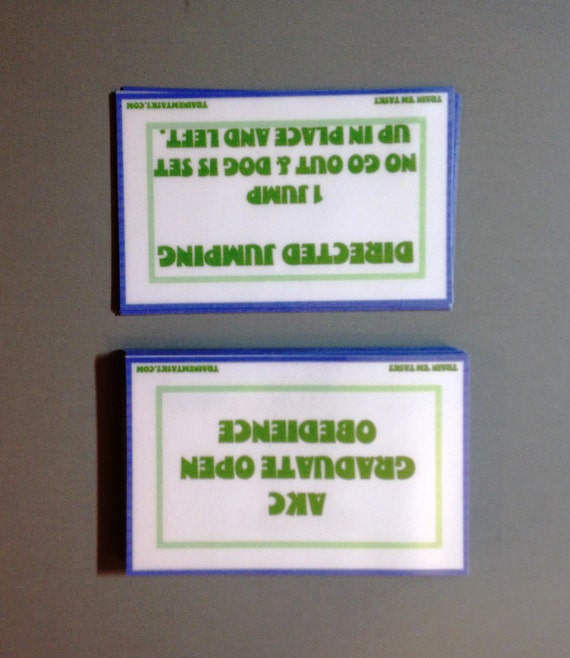
The last exercise in Graduate Open is the Directed Jumping Exercise. Since the Go Out is done separately from the Directed Jumping exercise in Graduate Open, the dog must be placed in position at the middle of the top of the ring by the handler. Just like in a recall, the handler will leave the dog and go to the middle in the opposite side of the ring and then face their dog. The judge will tell the handler which of the bar jump or high jump to send their dog over. Just like in Utility, the handler may turn towards the direct their dog is coming while the dog in the air over the jump. The dog has to front just like in a novice level recall and then finish. The GO directed jumping exercise is only one jump unlike Utility where the exercise is done only once.

If you and your dog are done with your CDX and are taking some time to prepare and train for the Utility ring but aren't quite there yet...Graduate Open is a good prep for the next step. I think that it could also be helpful for those handlers who have never set foot into a Utility ring before. Graduate Open might help those green Utility teams to work through some ring nerves for both the handler and the dog before hitting prime time in Utility A. So, if you're toying with the idea of getting your GO...GO FOR IT!! :D